“Bees are disappearing, disappearing… »
It is not enough to say, it is also necessary to understand why and act accordingly.
On earth for over 80 million years, bees have always survived successive climatic upheavals.

So why the alarm today?
Because their mortality rate has risen from 5% in 1995 to 30% and a third of what we consume is produced thanks to pollination. They are a vital link in our food supply.
Protecting bees also means protecting people. It’s time to act!
Are you ready?
Initiation and discovery: an educational kit
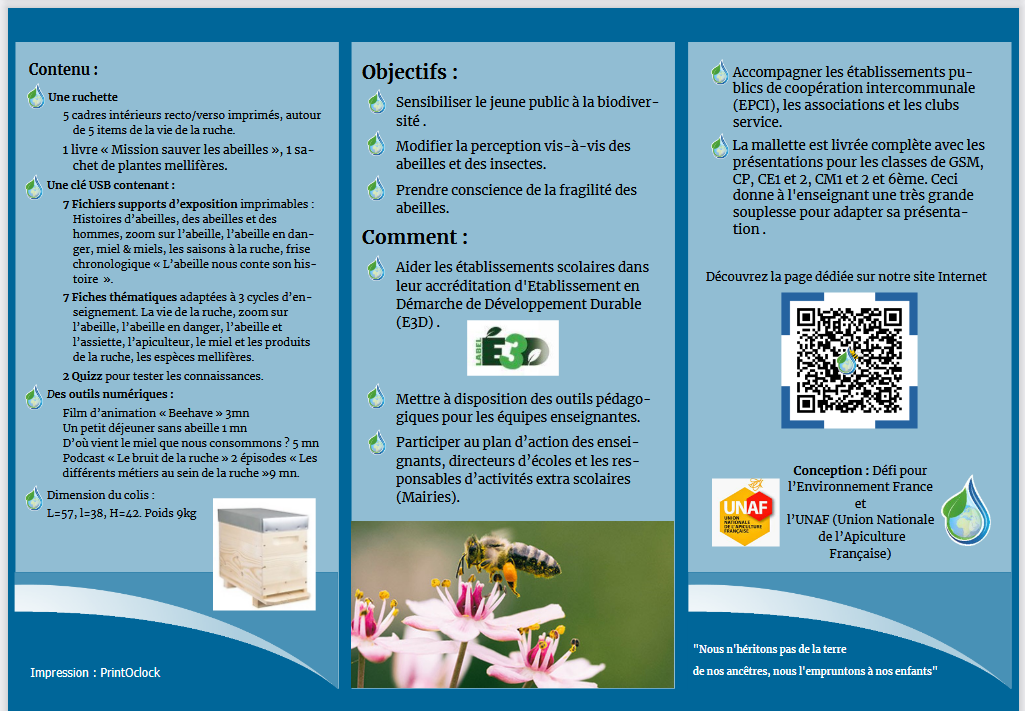
In partnership with the Union nationale de l’Apiculture française (UNAF), the Association Défi pour l’Environnement France offers an educational kit designed for children in the CM1/CM2 and 6°, cycle 3 classes of the French national education system.

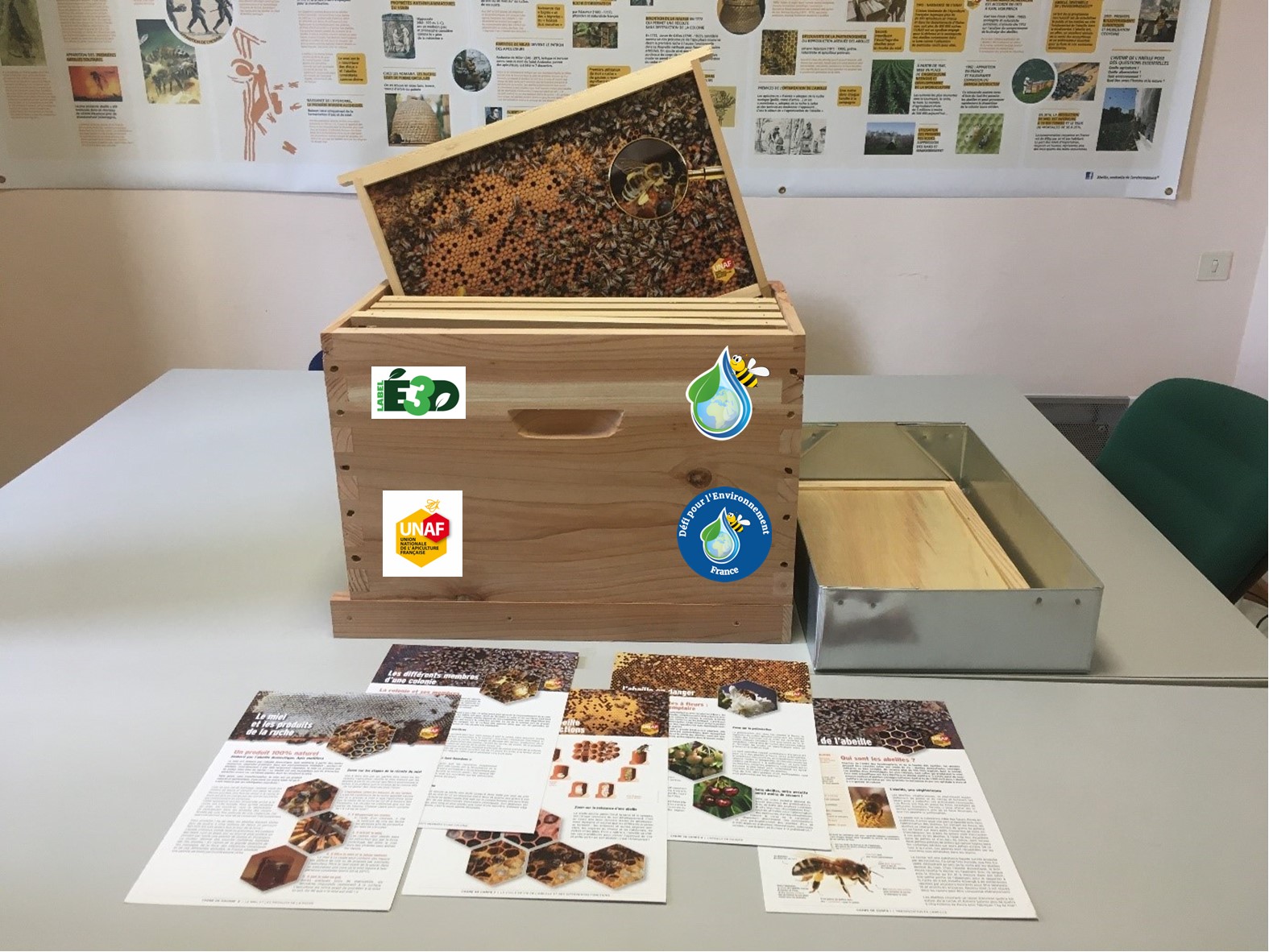
This kit contains a wide range of tools, including educational sheets to introduce you to the world of bees and biodiversity.
Ordering the Teaching Kit
CLICK HERE
Contents of the briefcase:
- A beehive
- 5 printed double-sided inner frames, around 5 items from the life of the hive.
2 books “Mission to save bees”, “The bee, Sentinel of the environment”. - Sachets of melliferous plants.
- 5 printed double-sided inner frames, around 5 items from the life of the hive.
- A USB key containing :
- 7 Printable exhibition files: Stories of bees, bees and people, zoom on the bee, bees in danger, honey & honeys, seasons in the hive, timeline “The bee tells its story”.
- 7 thematic cards adapted to 3 teaching cycles. The life of the hive, zoom on the bee, the endangered bee, the bee and the plate, the beekeeper, honey and hive products, melliferous species.
- Quizzes to test knowledge.
- Digital tools :
- Beehave” animated film 3mn
- A bee-free breakfast 1 mn
- Where does the honey we eat come from? 5 mn
- Podcast “The Sound of the Hive” 2 episodes “The
different jobs within the hive” 9 mins.
- Package dimensions: L=57, W=38, H=42. Weight 9kg
HERE, on the left:
The video explaining the different parts of this briefcase.
HERE, on the right:
The video (with English subtitles) explaining the different parts of this kit.
Below:
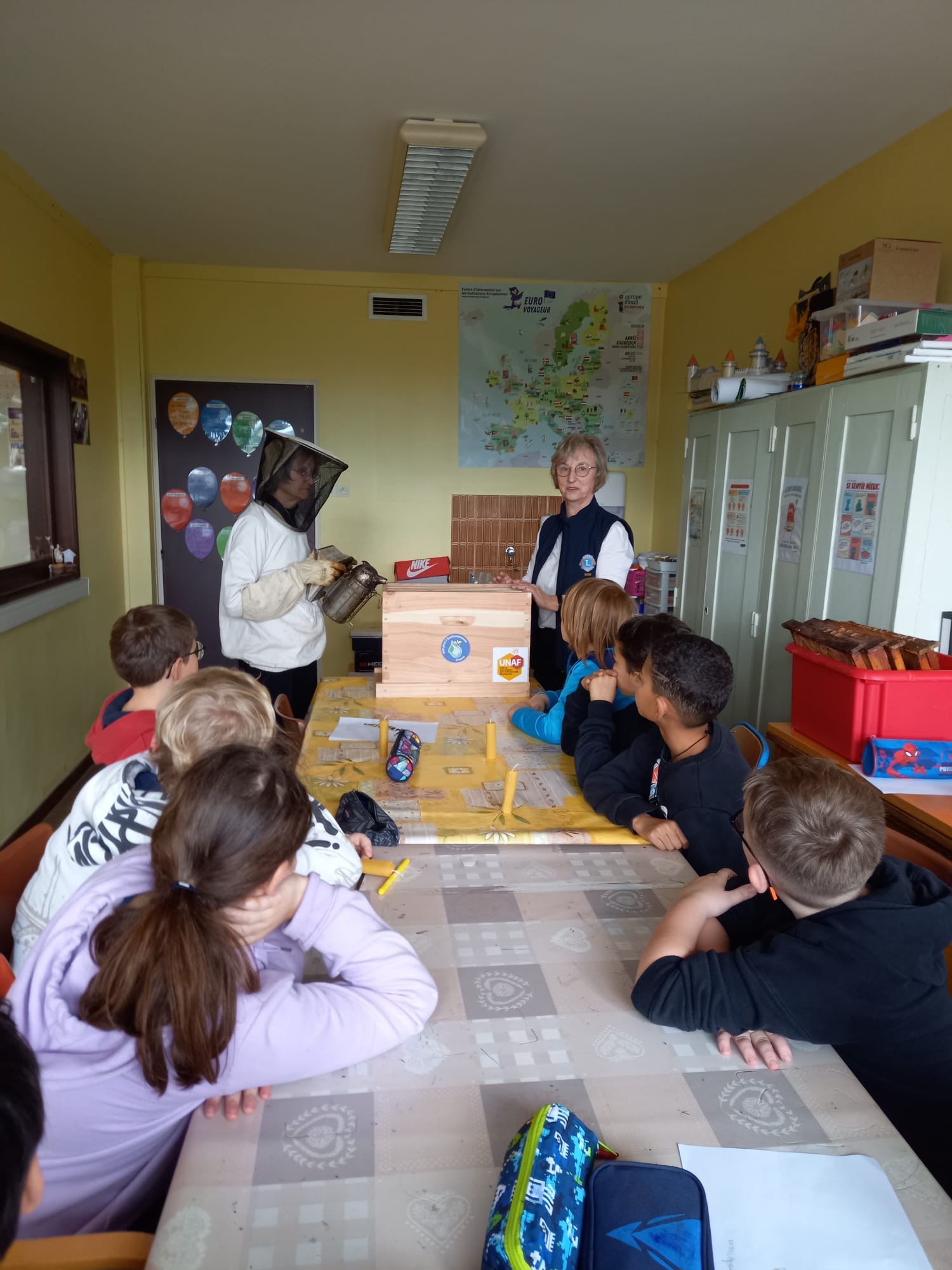
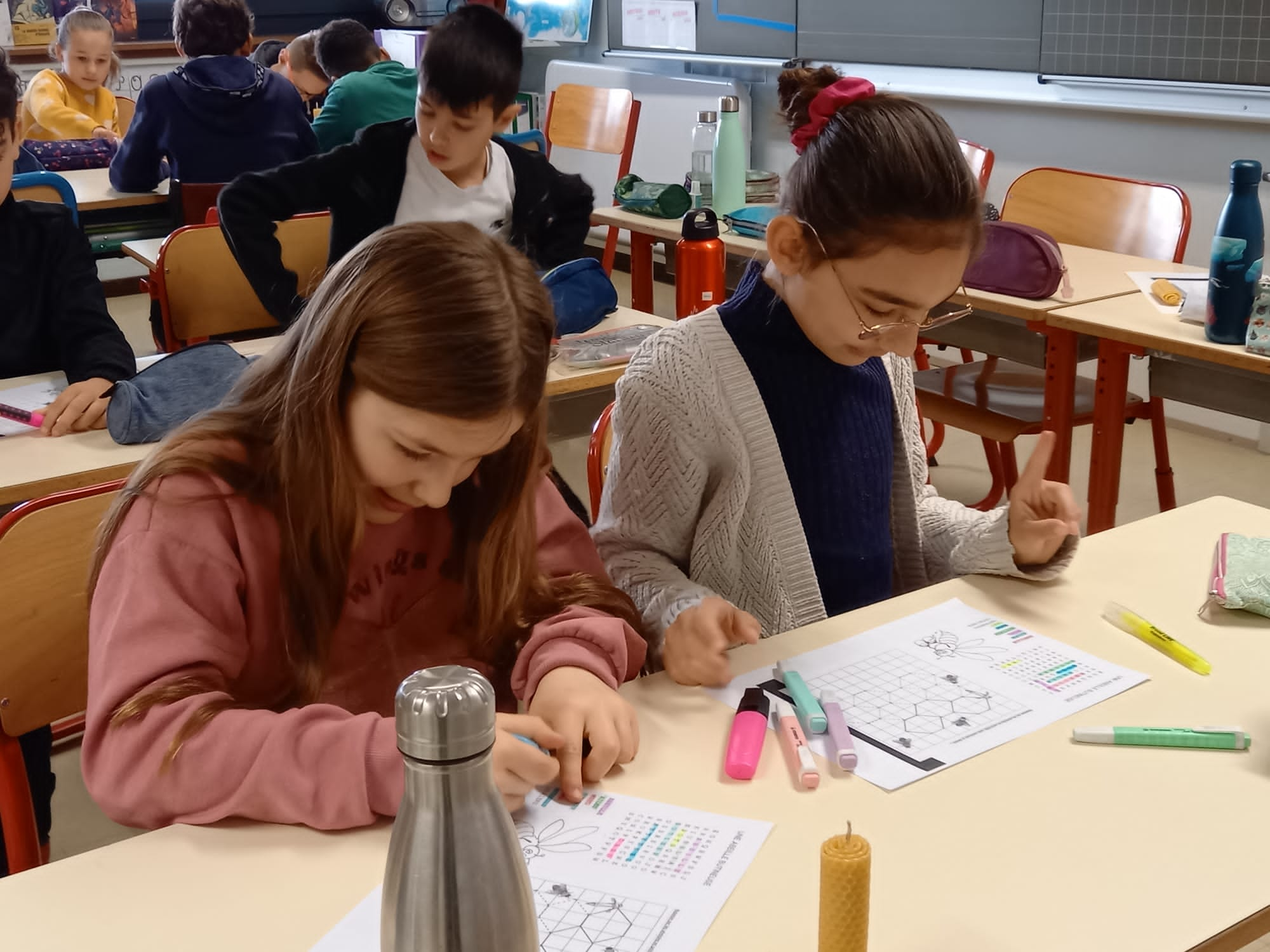
a discovery session in a school environment, with the help of a beekeeper
This is a fun way for students to get to know bees and take action on their behalf.
Data sheets have also been designed in collaboration with the French Ministry of Education, for teachers and supervisors with no prior experience in this particular field.
Ordering the Teaching Kit
CLICK HERE
contact : jean.marchal66@gmail.com
Henri Clément interview on Facebook
Presented by : Mélanie Taravant On the occasion of World Bees Day.
“Yes, you can have beehives at home!”
Henri Clément says it!
This beekeeper and spokesman for the UNAF (National Union of French Beekeeping) was the guest of the France 5 program “C à dire?!”,
on May 22, 2022 on the occasion of World Bee Day.
It was an opportunity for this enthusiast to return to the essential role of these pollinators, responsible for a third of the planet’s resources and yet in danger of disappearing. Faced with intensive farming and climate change, what are the issues at stake and what measures can each of us take at our own level?
Answer here …
The honey bee
Didier Grandperrin
Retired from the National Education, Biology-Geology teacher in preparatory classes for the Agronomic and Veterinary Grandes Ecoles
It is an insect known to all because of its habitat – it lives in hives (Figure 1) – and because of its productions: mainly honey and pollen. The Latins call it “apis” from which beekeeping is derived, beekeeper and the adjective beekeeping for everything related to beekeeping. So in beekeeping, the “a” has nothing to do with
Private!
1) What is a domestic bee ?
The honey bee has long been sought after by humans for its honey; as evidenced by cave paintings (Spain, South Africa) dated between 15,000 and 8,000 years ago.
The sculptures of various ancient Egyptian monuments depict cylindrical beehives. Closer to home, beekeepers have designed rustic hives made of hollowed-out trunks or made of wicker baskets sometimes covered in mud. The
Modern hives with removable combs
made up of a rigid frame supporting a wax comb are of recent invention (2nd half of the nineteenth century).
Figure 1 – Organization of a hive.
Domesticated, it has not always been and there are still wild colonies. Moreover, when a hive swarms, if a beekeeper does not capture the swarm, he settles in a dry protected place such as an old trunk, hole in a wall or in a
rock and returns to the wild.
Scientists call it Apis mellifera or Apis mellifica. Knowing that it makes honey from nectar, the name Apis mellifica is more accurate and therefore preferable. In Latin, fica means to make.
2) The social structure of honey bees
Honey bees live in well-organized societies made up of three castes: the workers, the males (or drones) and the queen. Each caste has specific roles.
Figure 2 – Dorsal views of the black bee (Apis mellifica mellifica).
The queen (15 to 20 mm long) is larger than other bees. Workers are between 11 and 13 mm long and males 14 to 18 mm long.
* The queen – She is easily recognizable by her large size and long, narrow abdomen. She is the only fertile female in the hive.
Unable to feed itself, it is in the care of the workers who feed it.
After its nuptial flight and during its long life (3 to 5 years), its main function is to lay eggs, up to 2,000-2,500 per day in the summer at the peak of its fertility.
She does not lay eggs during the bad season.
* Males – Recognizable by their stocky bodies and very large eyes, they do not possess a stinger and are therefore unable to defend themselves. Their main role is to mate with a virgin queen who will ensure reproduction.
They only live for one season.
Numbering between 2,000 and 4,000, only a few (3-4) will mate. At the end of the summer, they were rejected by the workers. Unable to feed themselves without the help of the workers, they perished.
Mating takes place in flight in good weather. The males of the hives in the neighbourhood gather between 10 and 30 metres above sea level in sites exposed to the sun and sheltered from the wind, thus forming “bee balls” that are sought after by virgin queens. At the end of mating, the male detaches but abandons his copulatory apparatus; for her part, the young queen gets rid of it and can mate again. The queen can thus unite with twelve to fifteen males in a nuptial flight. She will have accumulated enough seed for her whole life.
* The workers – Sterile females, they form the most numerous caste: from 40,000 to 80,000. They are the only ones responsible for “household chores and errands”: collecting nectar and pollen, producing honey, feeding the larvae, maintaining the hive and protecting them from predators.
Their longevity in the summer does not exceed 4 to 5 weeks; On the other hand, those born at the end of summer live nearly 20 weeks and spend the winter season. The following spring, when the queen begins to lay eggs, the workers are old.
3) The multiple tasks of the bee worker
In the summer, the activities of a worker depend on her age. Initially a cleaner, then a nurse, a wax maker, a storekeeper and then a caretaker or forager, but whatever her age, part of her time is devoted to resting or patrolling to ensure that the needs of the hive are controlled.
* A cleaner is dedicated to cleaning the hive: cleaning the cells, removing detritus from the hive (dead bees, excrement, wax debris) and repairing the wax combs.
* Having become a nurse, she prepares a porridge of pollen and honey given to the larvae who receive nearly 1300 visits every day. At this stage, the nurse has glands near her mouth – the mandibular glands – that produce royal jelly. During the first 3 days of their life, all larvae receive porridge and royal jelly but only the larvae that receive royal jelly all their lives will give queens. In addition to the larvae, the queen and the males who are unable to feed also receive their ration of porridge. After a few days, the mandibular glands cease to function and the worker ceases to be a nurse.
* It becomes a wax maker.
In the belly of the abdomen wax glands begin to function from which the wax lamellae emerge, which they use to build the combs and close the alveoli. Then, around 2 weeks, the wax glands stop working.
* The worker became a storekeeper.
It helps foragers back in the hive to unload their crops. If they are balls of pollen, she grabs them and packs them with her head into cells that will serve as a pollen reserve. If it is nectar, it stimulates the forager which regurgitates the nectar it has accumulated in a pouch in its digestive tract called the crop. In turn, it ingests this nectar, stores it in its crop and regurgitates it in a cell that will serve as a honey reserve. Whether she is a forager or a warehousewoman, the worker adds a little saliva and it is a mixture of saliva and nectar that is stored in the cells. This mixture is transformed into honey under the effect of salivary enzymes and, at the same time, is depleted of a good part of its water. When it is ripe and the cell is full, the wax boxes close the cell with a wax lid.
Truly made by bees from nectar, honey is a food rich in sugar and therefore essentially energy-intensive.
Then come the first flights out of the hive; These are learning and orientation flights: take-off, landing, re-take-off from the flight board but also reconnaissance of the hive and its environment.
Around the age of 3 weeks, the worker becomes a guardian and then a forager.
* The guardians (they are few in number) are sentinels placed at the entrance of the hive in a posture of vigilance, head and forelegs raised. Their role is to expel intruders (wasps, ants, mammals, birds) and to avoid looting by workers from other hives, which is common in years of scarcity. They identify the plundering workers by their flight swinging back and forth waiting for a propitious moment for the attack. When there is an attack, the guards call the other workers to the rescue.
* The harvests of foragers are nectar, pollen and propolis. Nectar and pollen are produced by flowers; some flowers provide both, others only one of the two. Nectar is a sweet juice that the worker collects from the bottom of the flowers with a tongue that allows her to lick the precious liquid. She stores it in a pouch in her digestive tract – the crop – and adds a little saliva to it. When her crop is full, she returns to the hive and passes it on to a storekeeper who will store it in a cell. The flowers visited depend on the length of the bee’s tongue and it turns away from flowers that are too deep and cannot penetrate. To collect the pollen, the worker penetrates the flower and rubs itself, snorting itself against the stamens. It covers its entire body with pollen that remains attached to the bristles covering its body (also known as “hairs”). Outside the flower, the forager regurgitates nectar and coats its body with it with its forelegs; The pollen is thus moistened with nectar.
It is therefore a sticky pollen that is brought to the hive in the form of balls. Making the balls is a complex operation in which the worker brushes her body with her paws so that the pollen remains accumulated, and then the forelegs and middle legs are stripped of their pollen passing between the hind legs. Finally, the pollen, clumped together and compressed, is accumulated in the form of balls carried in the baskets located on the outer surface of the hind legs. Brought back to the hive, the balls of pollen are taken care of by the storekeepers.
The queen and the males, without baskets, are therefore unsuitable for collecting pollen. Unlike honey, pollen is a source of protein and mineral salts.
Figure 3 – Forager in flight with her balls of pollen.
Propolis is a vegetable wax present on the surface of the buds; it is actually scraped by the worker with its mandibles and then brought back to the hive in the baskets of its hind legs, like pollen. The uses of propolis are numerous. Sticky and hydrophobic, it serves as a mortar for the storekeepers who seal the holes and interstices of the hive and protect it against humidity. It is also an antiseptic substance that prevents the development of mould. Finally, it is also used to mummify the corpses of intruders that are too large to be evacuated (e.g., mice), thus preventing their decomposition.
* Fan is an age-independent function. If the temperature in the hive rises dangerously, all the workers in the hive are able to flap their wings whether in the hive or on the flight board. This creates an air circulation that ensures the thermoregulation of the nest thus protects the larvae from excessive temperature and participates in the maturation of honey.
4) Diversity of European honeybees :
The honeybee’s natural range initially covered Europe, Africa and the Near East. In Europe, the Apis mellifica species includes several subspecies, each adapted to distinct climates and habitats. They are distinguished by their physical characteristics (measurements, “hairiness”), their nesting method, the types of plants they forage, etc. The main ones are the black bee (Apis mellifica mellifica), the Italian bee (Apis mellifica ligustica) and the Caucasian bee (Apis mellifica caucasica) and the Carniolan bee (Apis mellifica carnica), each with specific physical, behavioral and physiological characteristics.
* The black bee owes its name to its colour. It is a very old variety present in Western Europe and can be found in all regions of France. It is very popular with French beekeepers because it winters remarkably well, even when the winter is long and cold as in a mountain climate. Resistant to diseases, with a good longevity, it is well adapted to its environment. It is sometimes criticized for its aggressive behavior and its somewhat slow development at the end of winter. In addition, its short tongue prevents it from foraging from flowers with deep corollas.
* The Italian bee owes its name to its geographical origin. It is the most widespread bee in the world (Europe, America and Australia) because of its many qualities: a gentle species producing a lot of honey, it propolises little and develops quickly from the first sunny days. Greedy during the winter and sensitive to the cold, it has difficulty spending the winter beyond the Mediterranean climate. It is very fertile and produces a lot of swarms, which can represent a loss for the beekeeper
.
* Native to the Caucasus Mountains, the Caucasian bee is present in most honey-producing countries. It is a grey and very “hairy” bee known for its gentleness. Its very long tongue allows it to forage on deep flowers (acacia, alfalfa, etc.). Very active, it produces a lot of honey and propolis, a substance with recognized health properties. It is winter hardy but develops slowly in spring. It is often crossed with the Italian bee.
* The Carniolan bee is native to the Carpathians. It is a large grey bee. It is appreciated because it is one of the bees that overwinters best and, being very gentle, it rarely stings. As it develops quickly at the end of winter, it gives beautiful spring honey. In addition, it propolises and consumes little. On the other hand, it is a swarmer and a bad builder.
Obviously, for the needs of beekeeping, transfers have modified the initial geographical distribution and various hybrids have been created combining – with more or less success – the qualities of different varieties such as sweetness, resistance to diseases. •••
The social life of honey bees
The life of a hive containing thousands of individuals is largely based on communication between bees, communication that is essential for the achievement of essential needs such as construction, feeding, reproduction and defence.
In the honey bee, there are many means of communication between individuals:
– thanks to the emission of various chemical messages (pheromones), the queen, the workers and even the larvae transmit information that ensures the cohesion of the hive;
– Through vibrations, antennal contacts and complex dances, the foragers inform those who will go out to collect nectar and pollen or look for a new home.
All these means of communication, essential to the life of the hive, mean that the honey bee cannot live in isolation from its congeners; The honey bee is a social insect.
1) The construction of the combs: a collective activity
* When the workers become wax makers, they also become builders. To build the spokes, they start at the top, whether it’s the ceiling of a cavity or the top bar of a frame.
Attached to each other by their legs, they form a chain dangling in the air. This chain works from the bottom up: thanks to her hind legs, a builder collects the wax strips that come out of the underside of her abdomen and then she brings them to her mouth and crushes them by impregnating them with saliva. The result is pellets which, transmitted from one place to another, go up the chain from wax to wax before reaching the top, to the bees in charge of building the cells. In the chain of wax boxes, the builders move but from this apparent disorder will emerge a perfectly regular and vertical ray, the bees perceiving gravity. Each bee in the chain perceives the progress of the construction at any time and participates in its progress.
* The manufacture of wax combs is very energy-intensive, first during the synthesis of the wax by the stretcher glands – about 8 kg of honey for 1 kg of wax – and then during construction. In addition, the wax changes over time: first white and malleable, it becomes yellow, then brown, then black but also brittle.
The builders repair the combs, plug their orifices and renew them by gnawing on the old wax and replacing it with fresh wax.
This debris of old wax is thrown out of the hive by the cleaners.
Geometry of wax rays
In the hive but also in the nest of wild bees, the wax combs are vertical. more or less parallel. Their hexagonal cells are arranged back to back but slightly angled so that the opening is located higher than the bottom, which prevents the honey from flowing.
The interval between two combs is such that the bees can cross paths and circulate quickly in the nest. The size of the cells (width, depth) is specific to each variety of honey bee.
Note that the hexagonal shape offers the best surface/volume ratio, allows the greatest number of cells per unit area and optimal solidity in relation to the thinness of the walls. In comparison, circular, octagonal, or pentagonal cells would leave empty spaces (Figure 1b).
* The construction of wax combs has an invisible consequence. Indeed, the crushed wax, kneaded with saliva, is also impregnated with the body odor of the workers. As a result, the whole nest is marked by the smell of the group, an odor perceived by all the bees in the hive.
We can really talk about the smell of the group or the smell of the nest.
The shape and dimensions of the cells constructed by the workers depend on their fate.
– Small hexagonal cells (about 840/dm2 for European bees) are the most numerous and are used to store reserves (honey, pollen) and to raise worker larvae.
– Large hexagonal cells are less numerous. Arranged on the periphery of the combs, they occupy only 10 to 15% of the comb surface and are used first to raise male larvae and then to store honey.
2) Nurses: food and care of the brood
The name brood is given to all tuffs, larvae and pupae. In a hive, the brood is mainly located in the body of the hive.
* The queen’s pundits.
The queen lays two types of eggs:
– fertilized eggs that will give birth to females, queen or worker depending on the food given by the nurses;
– unfertilized eggs that will give birth to males.
Development – from egg to bee – takes place in the cell where the queen has laid. After hatching the egg, the larva formed grows thanks to the food provided by the nurses and then transforms into a pupa. Before this transformation, the wax beds show an operculation behaviour: they close the cell with a wax seal and it is therefore in a closed vacuum, in its cell, that the bee completes its development. The development time is on average 16 days for a queen, 21 days for a worker and 24 days for a male in European honeybees, at the end of which the bee emerges from the cell by cutting the operculum with its mandibles (Figure 2)
* Brood care.
The care provided to the larvae by the workers is adapted to the needs because they know how to identify the sex, caste and stage of development of the larvae. This is based on the perception of signals emitted by the larvae or nymphs.
.
Duration of development of the different castes:
24 days for males,
21 days for workers and 16 days for queens.
The capping of the cells is carried out for 7-8 days for future queens, 9 days for future workers and 10 days for future males.
Queens and workers are females born from the development of fertilized eggs.
Males are born from the development of unfertilized eggs.
Nymphs are distinguished from larvae because they already have all the attributes of their caste (head, thorax, abdomen, legs, wings, antennae, mouthparts).
The larvae produce a brood pheromone, a cocktail made up of a dozen chemical compounds, a pheromone that acts remotely on the nurse workers.
This pheromone stimulates their production of royal jelly and slows down their behavioural development: they will forage later.
The capping behaviour is triggered by fatty substances present on the surface of the larvae’s bodies a few hours before and after capping. For worker larvae, this occurs when they are 9 days old from hatching. Similarly, before capping, queen larvae emit a substance that attracts and groups workers around their cells and therefore prompts care.
3) The Queen’s Pheromone
(Figure 3)
* Careful observation of the queen in the hive or in the nest shows that she is constantly followed by workers who remain in contact with her, care for her and feed her.
We are talking about courtship behavior; This behavior is due to a pheromone produced in the queen’s mandibles. This pheromone flows and remains on the surface of the queen’s body; It is transmitted by contact to his yard and then from one to the next to all the occupants of the hive. This pheromone, called the royal pheromone, has multiple effects: in addition to attracting and cohesing its court, it exerts an attraction on all the occupants of the hive and also has the effect of inhibiting the development of the workers’ ovaries, inhibiting the construction of queen cells, attracting bees during swarming and attracting males during nuptial flights. It is therefore responsible for the cohesion of the hive and regulates its activities.
The production of the royal pheromone is at its highest in the young queen, between 6 and 18 months.
* The queen pheromone may be lacking when the queen dies but also become quantitatively insufficient as it ages and/or when the hive becomes very populous. In this case, the workers build queen cells (about ten), large cells that hang from the surface of the rays, most often in the lower part.
– In the most favourable case, the eggs contained in these queen cells will evolve into larvae which, fed with porridge supplemented with royal jelly, will give birth to queens. It is a royal breeding, piloted by stretchers and nurses. As soon as a first queen emerges, she goes in search of the other royal cells to kill the occupants as soon as they emerge with her stinger except… if the workers prevent it. The hive is then endowed with several queens, a prelude to a future swarming
– The unfavorable case occurs when the queen dies without having laid fertilized eggs, then there is no royal breeding possible. The ovaries of the workers will develop but, due to a lack of mating, they will only lay unfertilized eggs, giving birth to males. The end of the hive is then inevitable.
4) Worker pheromones (Figure 3)
As we have just seen, the queen and the brood produce pteropods; in the other caste, the workers produce at least three.
* The booster pheromone is released by light workers in a variety of situations. It is produced by glands located on the back of the abdomen and released during a recall posture in which the worker raises the abdomen while exposing these glands and ventilating. And since the constituents of this booster pheromone are very volatile, they are perceived by other workers. at the entrance to the hive or nest, this recall pheromone has the effect of guiding the returning luminous ones and the lost foragers, but also of recruiting other workers who adopt the same posture; the message is therefore quickly amplified The luminous water correctors, an odorless liquid, do the same to attract other luminous ones to the sites; This optimizes water collection. Finally, the booster pheromone contributes, along with the queen pheromone, to the cohesion of the swarm in flight and to the formation of the cluster (see article .-1 below).
* The alarm pheromone is released by the guarding workers on patrol at the entrance to the hive or nest. It is secreted by glands located at the level of the stinger. When a danger approaches, the guards adopt a posture…….
<<—-HERE description figure 3
Sites of secretion of the main pheromone glands of the queen and the workers. In the queen, the royal pheromone is secreted by glands located in the mandibles; the same is true for the mandibular pheromone of the workers. Finally, in workers, the glands producing the alarm pheromone are located at the level of the stinger (do not confuse the stinger with the stinger of the stinger); As for the booster pheromone, it is produced by a gland located in a dorsal position in the abdomen.